
Kariz in Nurata
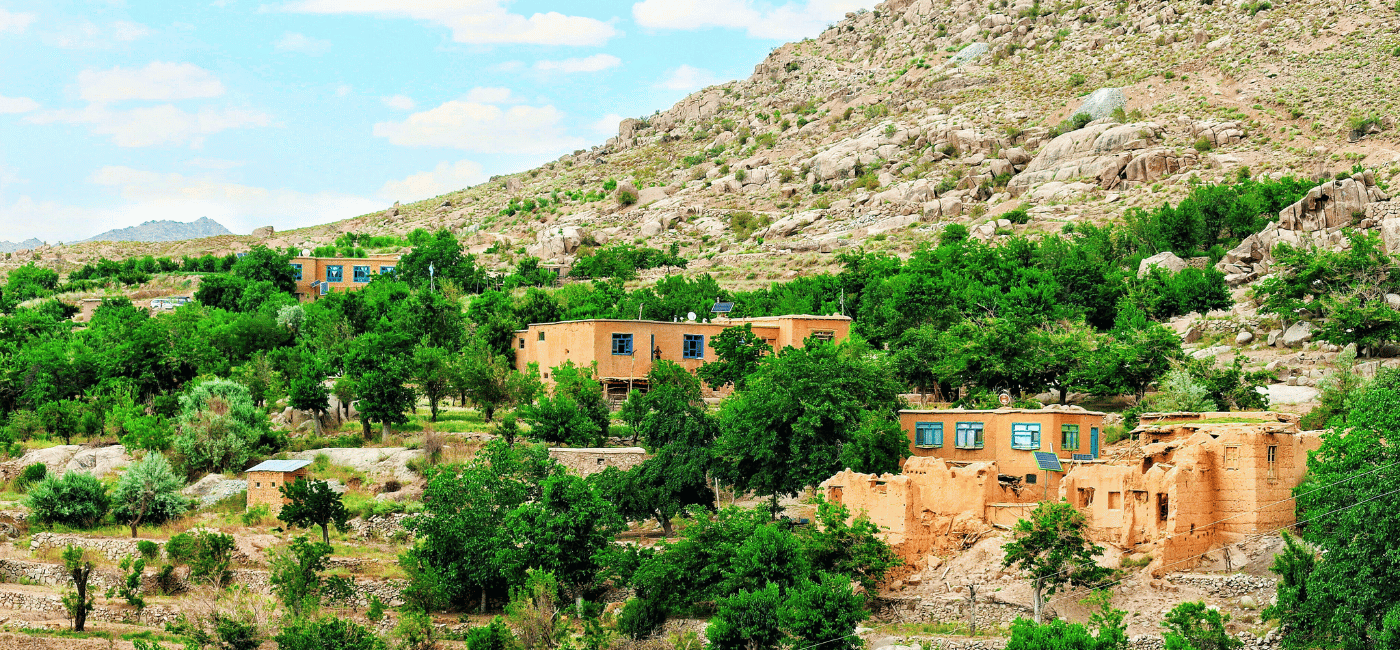
Kariz
Kariz is an underground canal connecting the place of consumption with the aquifer. They, as a rule, had a gallery with a cross-section that allowed people digging it to pass freely.
This underground system in Nurata is associated with the name of Alexander the Great, who invaded Central Asia in 329-327 BC. According to legend, when Iskander Zulkarnayn, as the locals called him, brought troops to the Zarafshan Valley, he climbed the highest peak of the southern wing of the Nurata Mountains - Aktash.
Looking towards the south, he saw the Zarafshan River and a landscaped valley, and in the north - wide empty fields. And then he said, "The river of this area flows underground." Thus, the Macedonian ordered his army to dig kariz. As a result, they dug 366 underground canals, and Nurata was improved.
Without a doubt, this is not just a legend, but the result of the experience of local residents who have been observing the hydrogeology of Nurata for many years, taking into account its natural features. The term "Kariz" comes from the Persian-Tajik language, formed from the combination of the words - "kakh" - straw and "rez" - to pour out.
The ancestors, in order to check if the water flows correctly, threw straw into the well and watched it come out of the last well. Thus, they determined whether the water flows evenly, what its level. According to legend, Alexander the Great came to Nur, saw a crowd of people who stood at the last well and shouted: "Karabkakh cut!" ("Throw the straw!").
For the construction of kanats, experienced irrigators first made several wells in a checkerboard pattern. When the water level in them dropped, they dug kariz. The work began with leveling - determining the difference in heights of two or more points on the earth's surface relative to the conditional level. This played an important role in the course of the Kariz route and the removal of water to the surface of the earth through them.
When determining the route of underground canals after leveling, two or three people participated. One of them, to determine the latitude, observed from above over the well using one of the oldest astronomical instruments - the astrolabe. The second, in the direction where the water comes from, vertically lowered a wooden rod equal to the depth of the well. So, through the diopters of the astrolabe, its directness was determined.
The spirit level tool was also used to assess the conformity of the surface to the plane. After leveling and distributing the kariz, wells were dug for every 10 meters along the route. The depth of the layer where water accumulated was 18-20 meters, sometimes even more. The wells were closed by a tunnel called "lahm". Groundwater flowed out through them. The depth was 1.25-1.5 meters, the width was 1 meter, and the length was several meters.
When digging a well, the most important job was considered to be the construction of a tunnel, which should not have twisted to one side. All this information was studied by the local historian R. Akhmedov. In Nurata there is a kariz called "Zulmkariz" ("zulm" - oppression). According to legend, it bears this name for the reason that Alexander the Great behaved cruelly towards the workers during construction. At the time, conditions were extremely difficult.
In the foothill regions of Uzbekistan, they still use karizes. This old type of irrigation technique in the Nurata region is called "Alexandria" by the locals. Karizy Tovboy, Kainar, Boshkoriz, Mazor, Kuvondik, Kunchi, al-Bukhari (Alpukhori), Satilgon, Miri, Yalok, Tylok, Sulton, Maston, Mastak, Komboy, Zulfikar, Kalta-Kariz could eventually be renamed.
It turns out that each of the Nurata Karizes irrigated an area of up to 40-50 hectares. The water in them was measured in days, the people of Nurata called it "shabi-ruz" - "day and night". One shabi-ruz equals 96 obi karoi (black water). Water in Kariz was highly valued, and farmers had the right to sell it. "Black water" was equal to the price of 20-25 sheep. Due to the shortage and high cost of life-giving moisture, the one who bought water or received it as an inheritance after the death of his father, arranged a feast for the people and dressed tun (chapan) for prominent figures and aksakals.
The feast, which was held on the occasion of the purchase of water, was called "nimmardi", and on the occasion of the inheritance of water - "padarimurd". Today the kanats are abandoned, some of them are buried. Only from Kalta-Kariz water flows.
List of Top Sights to See in Nurata
| Chashma Complex | Fortress of Alexander the Great |
| Kariz | Namazgah Mosque |

