
Stupa Zurmala in Termez
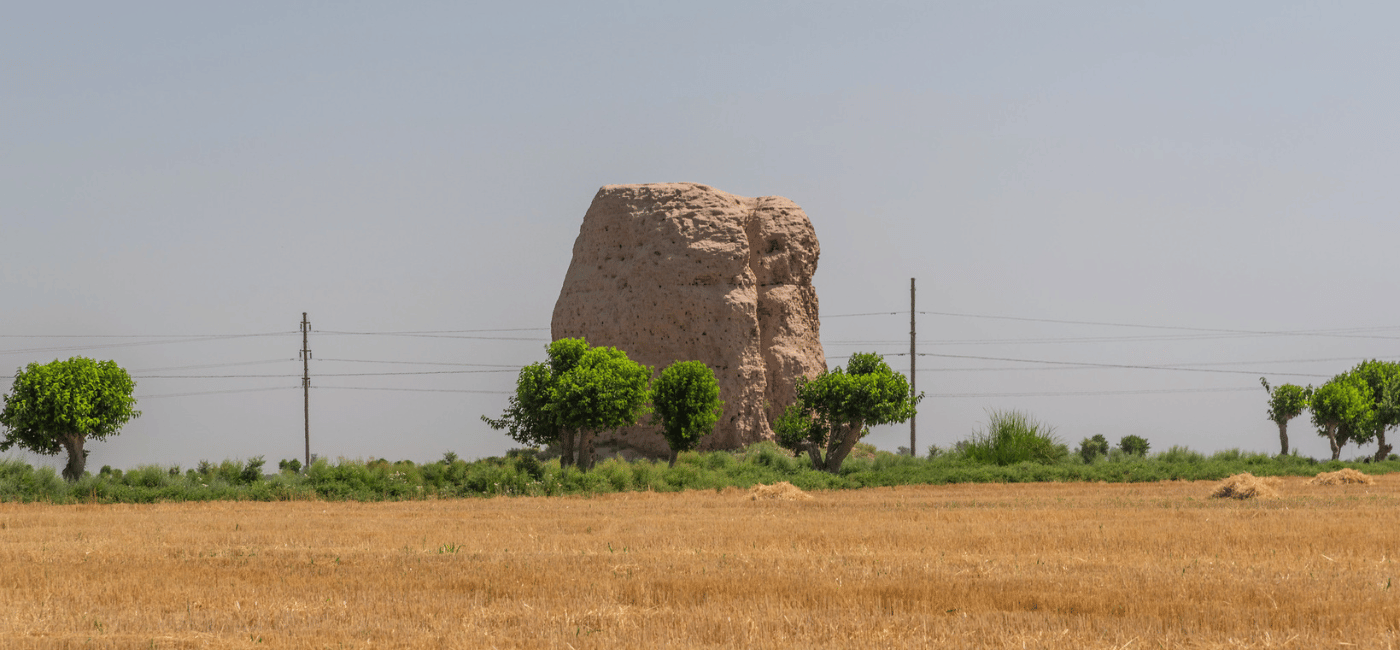
Stupa Zurmala
To the southeast of the Old Termez settlement, next to the road to Termez, there are the remains of an unusual cylindrical structure known as the Zurmala Tower. This is a cult building dating back to the heyday of the Kushan kingdom, i.e. by the beginning of the 3rd century A.D.
Archaeologists who investigated this object confirmed the existing hypothesis that this is a Buddhist stupa. The ancient Buddhist stupas, including Zurmala, were a brick-built cylinder with a spherical end.
Such structures symbolized the death and burial of Buddha, and also served as a repository of Buddhist relics. Like all ancient stupas, the Zurmala tower is lined with square-shaped mud bricks. Each of them bears a stamp characteristic of the Kushan era.
The construction of such a tower required at least 1,200,000 of these bricks. The Zurmala stupa stands on a platform oriented to the cardinal points and rises 13 m above it.The diameter of the stupa at the base is 14.5 m.
According to the research of archaeologists, initially the total height of the building exceeded 16 m. The tower was badly damaged from time to time. Several basic details characteristic of Buddhist stupas have not survived: the tower was supposed to be crowned with a special chamber for storing relics (sacred texts, statuettes or particles of the relics of the Buddha himself), a rod towered above it, on which, in turn, were attached "umbrellas of honor" - symbols the nobility and enlightenment of the Buddha.
Only the brickwork of the tower with a spherical end has survived to this day. The Zurmala Stupa is the first building of the Buddhist era, opened in Central Asia in the 20th century.
In total, about 40 Buddhist monuments were discovered and investigated in the Central Asian region, and half of them are on the territory of modern Uzbekistan. One of such rare and unique finds of the 2nd century BC Buddhist stupa in Old Termez.
A cylindrical monolith, once crowned with a dome, is erected on a rectangular stylobate. Judging by the fragments found, the Zurmala stupa was once faced with red burnt bricks and stone blocks with high reliefs depicting scenes from Buddhist mythology.
List of Top Sights to See in Termez
| Al Hakim At-Termiz Mausoleum | Fayaz Tepa |
| Fortress Kirk Kiz | Friendship Bridge |
| Jarkurgan Minaret | Karatepa |
| Kokildor-Ota Khanaka | Stupa Zurmala |
| Sultan Saodat Ensemble |

