
Khoja Berdibai Madrasah in Khiva
Khoja Berdibai Madrasah
The Khoja Berdibai Madrasah, constructed in 1688, is one of Khiva's oldest and most significant educational landmarks. Situated near the eastern Palvan-Darvoza gate in the historic city of Khiva, Uzbekistan, this madrasah stands as a remarkable example of Islamic architecture and serves as a lasting symbol of the region's commitment to scholarly pursuits along the Silk Road.
Architectural Highlights
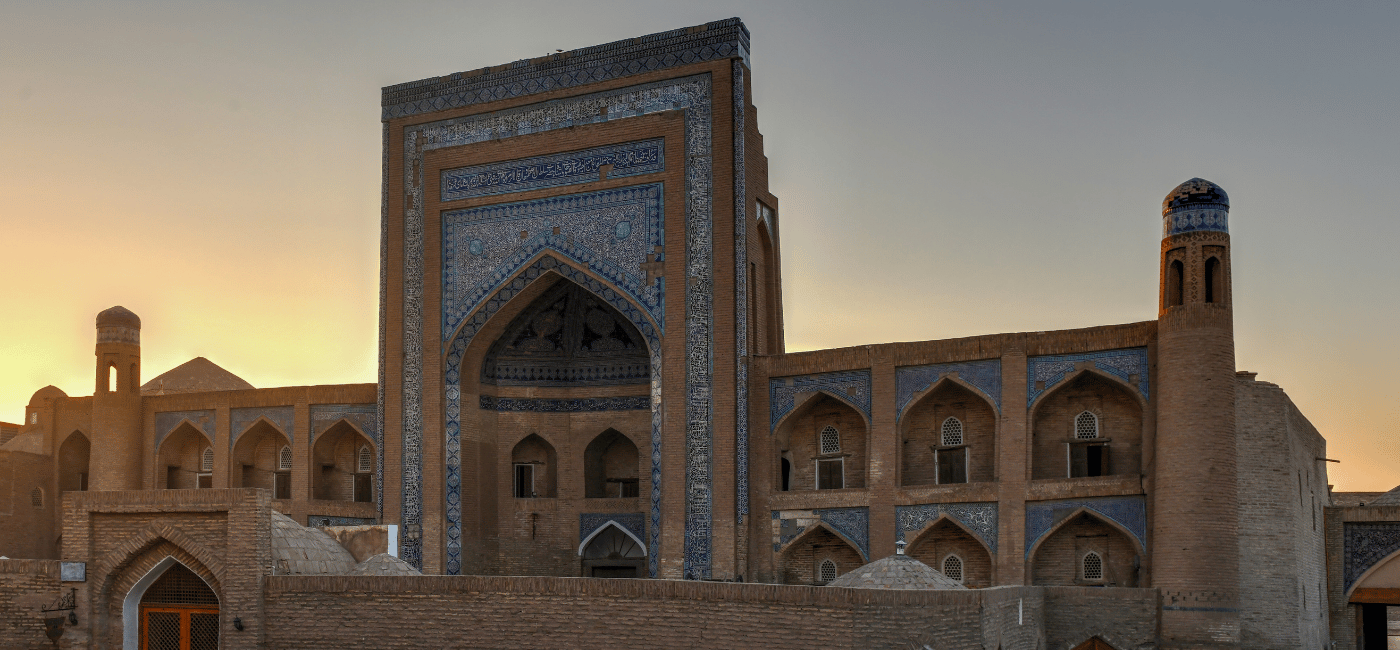
The Khoja Berdibai Madrasah is designed as a single-story rectangular complex built from traditional baked brick. Its architectural composition includes a central courtyard surrounded by 99 hujras (student cells), classrooms, seasonal mosques, a library, and utility spaces, creating a fully functional center for advanced Islamic education. Although modest in scale compared to other Khivan madrasahs, its structure reflects the refined architectural sensibilities of the period, emphasizing both simplicity and elegance.
One of the madrasah's distinctive features is its delicate wooden craftsmanship. The building incorporates beautifully carved wooden lattices known as pandjara, which adorn the windows and allow filtered light to enter the interior spaces. The entrance is embellished with traditional wood carvings, showcasing the exceptional artistry of Khiva's craftsmen and contributing to the site's aesthetic charm.
Historical Evolution and Cultural Significance
During the construction of the nearby Allakuli Khan Madrasah in 1834, the Khoja Berdibai Madrasah underwent significant urban realignment. Its proximity to the newly constructed madrasah led to the combined reference of the two complexes as the "Khurjum Madrasah," a term meaning "paired saddlebags" in Uzbek. This integration symbolizes the close architectural and educational connections between Khiva's learning institutions and highlights the evolving urban fabric of the city during the 19th century.
Beyond its architectural merits, the Khoja Berdibai Madrasah played a crucial role in Khiva's religious and intellectual life. It served as a hub for Islamic studies, focusing on subjects such as theology, Arabic language, and Quranic teachings. Its contribution to the spiritual and scholarly development of Khorezm makes it a vital monument within Uzbekistan's cultural heritage.
A Legacy of Education and Heritage
Today, the Khoja Berdibai Madrasah remains an integral part of Khiva's UNESCO World Heritage-listed Itchan Kala. Though it no longer operates as an educational institution, it offers visitors a chance to explore the intricate architecture and immerse themselves in the history of Khiva's vibrant Islamic learning tradition. As one of the many treasures preserved within the ancient walls of Khiva, this madrasah provides an insightful glimpse into the spiritual and academic life that flourished along the Silk Road.
For travelers journeying through Uzbekistan, a visit to the Khoja Berdibai Madrasah is an essential stop, offering a rich encounter with Khiva's architectural beauty and its enduring legacy of education and culture.